A sense of wonder can improve our physical and emotional health
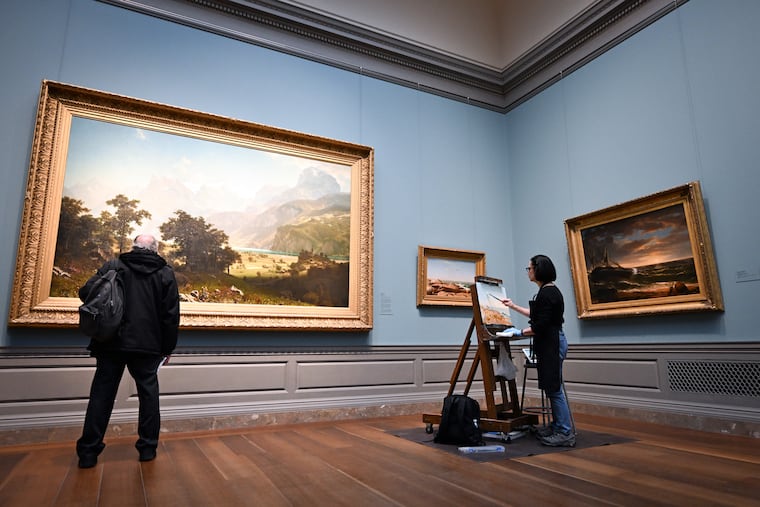
I just had a most eventful week. I watched in horror as a terrible storm in the Mediterranean dashed a ship against a rocky coast, forcing its crew and passengers into a desperate attempt to save themselves and rescue their cargo. I soared with the birds among snow-covered peaks in the Rockies, marveling at the many shades of white and blue. And I joined picnickers on a serene hillside along the Hudson River, where I watched the sunlight and clouds play above a sheep pasture and a tiny village beyond it. What’s more, I did all of this in just 90 minutes at the National Gallery of Art in Washington. I took the museum’s “Finding Awe” tour and, with the help of staff, unlocked a sense of wonder I did not know I could feel while looking at art — in this case, a 1772 shipwreck scene by Claude-Joseph Vernet, a 1946 abstraction by Georgia O’Keeffe, and an 1860 landscape by Jasper Francis Cropsey. The National Gallery, working with University of California at Berkeley psychologist Dacher Keltner, has so far hosted 36 awe tours for the 800 people lucky enough to get a slot. You can also take a self-guided awe tour using the museum’s tools, or apply the same techniques to experience wonder while looking at art anywhere. A growing body of evidence demonstrates that the experience of awe that visual arts can trigger has mental and physical health benefits for us. They are similar to the restorative effects produced by awe-inspiring natural settings, such as a mountain vista or open sea, but we can access them more easily. The best part is you don’t need to know anything about the art you are looking at. “In some ways I think it’s actually easier if you don’t have an understanding,” National Gallery of Art Director Kaywin Feldman told me, because “that moment of ‘oh my goodness’ is part of wonder. You have to sort of stop in your tracks, have that moment of surprise.” This was excellent news for me, because that one semester of art history I took in college didn’t stick. Until now, the primary feeling I’ve had when visiting a museum has been drowsiness. I call it “museum head.” I race through one of the world’s best collections — the Louvre, the Uffizi, the Prado, the Met — and glimpse as many works of art as I can take in until, overstimulated and overwhelmed, I find a seat near the gift shop and wait for the others in my party to finish. But now I know the cause of museum head: I was doing it all wrong. The way to experience awe in visual art — in fact, the way to experience awe in any setting — is to slow down. The point is not to see it all but to see a few things, or even one thing, deeply. Feldman’s first such awe experience came in Padua, Italy, when she was 22 and, though hungry, tired, and dirty from her travels, she decided to see the Giotto de Bondone frescoes in the Scrovegni Chapel. “When I walked out of that chapel, I felt like I was walking on a cloud,” she recalled. “I thought life was so beautiful, such a gift. I fell back in love with humanity and felt such optimism for the future.” Since then, she has made it her life’s work to help others experience such moments of wonder. She told me she once kicked a pair of donors off a Florence art tour when they declined to visit the Uffizi because they already “did it” decades earlier. “You’re there to have an experience, not to check something off the list.” To illustrate, she took me to see a 1659 self-portrait by Rembrandt and instructed me to study his face, brightly lit while all else in the painting was in shadow. His dark eyes locked on mine even as I moved from side to side. I studied the wrinkles in his forehead, the folds under the eyes, the loose flesh in the pallid cheeks. I could see a blood vessel on his bulbous nose, the whiskers of his thin beard and the individual curls in his hair. I saw sadness and maybe worry in that face. After I took that in, Feldman explained the sadness. Rembrandt, 53 in the portrait, had just gone bankrupt and had to move from his home and sell his possessions. He had lost his wife and several children and had a financial dispute with a partner. “He’s looking at you and connecting and asking you to acknowledge him,” she said. For her, the wonder comes from this “direct connection with somebody who is no longer alive.” I held the great man’s gaze from across the centuries and I felt a chill. This connection to immortality made my daily vanities and worries seem small and insignificant. It reminds us, as Feldman put it, that we are “part of something bigger.” New research out of King’s College London gauged people’s physiological responses while they viewed works by Paul Gauguin, Vincent van Gogh, Edouard Manet, and Henri de Toulouse-Lautrec for 20 minutes. The study, now in preprint, found that participants’ levels of the stress hormone cortisol dropped by 22% on average, while markers of inflammation dropped even more sharply and heart rhythms indicated greater relaxation. This is consistent with other recent research c