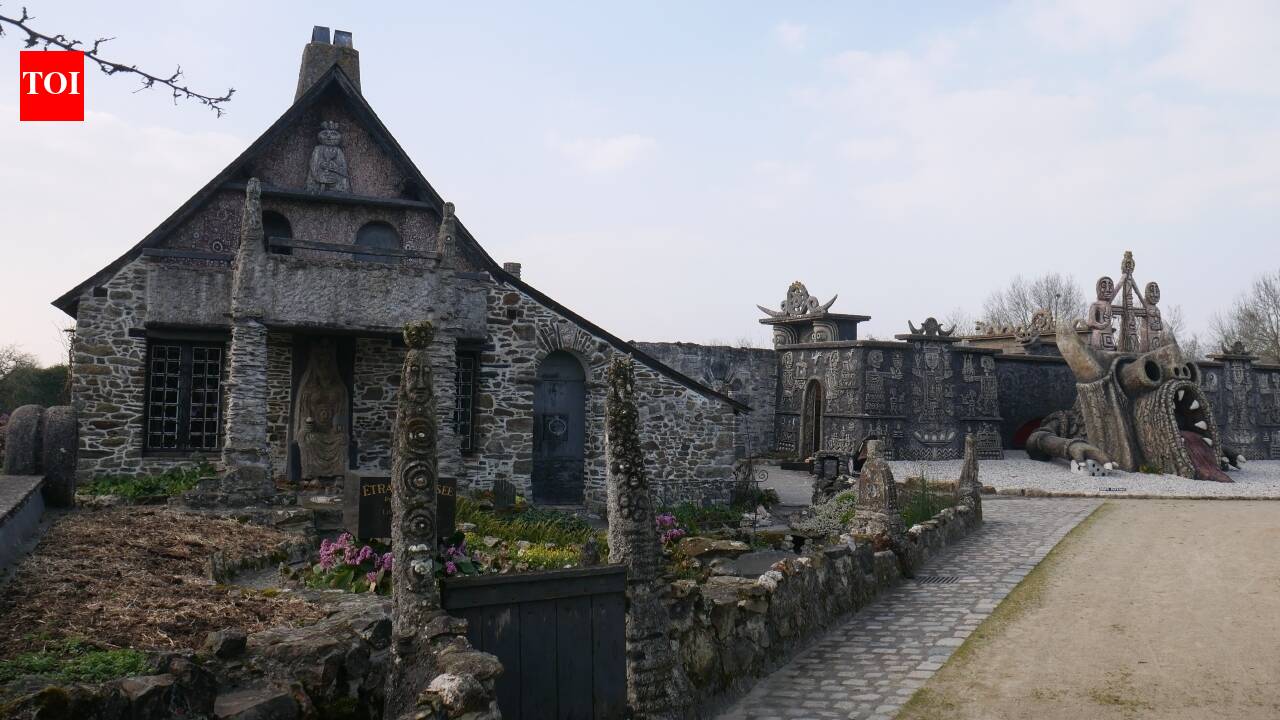
At 60, French artist Robert Tatin began a 21-year sculptural project around his home, filling the grounds with towering painted-cement figures, gates and gardens
At the age of sixty, French painter‑ceramist Robert Tatin abandoned a conventional studio career and embarked on an ambitious, twenty‑one‑year sculptural venture that would transform the grounds of his modest home in La Frénouse, Mayenne. Drawing on his experience with Brazilian construction projects and on advances in reinforced cement, he set out to create a living museum that would merge art, architecture and landscape.
The result is a winding avenue called Allée des Géants, an 80‑metre stretch lined with nineteen towering painted‑cement figures that range from Joan of Arc to the writer Alfred Jarry. At its head stands the Gate of the Giants, a high‑relief façade populated by portraits of masters such as Rembrandt, Van Gogh and Leonardo da Vinci. Beyond the gate lies the Garden of Meditations, a 500‑square‑metre sanctuary that moves from a Sun Gate at sunrise to a Moon Gate at sunset, centering on a 6.5‑metre statue known as the Lady of All the World and a series of twelve sculptures representing the months, all set around a small reflecting pond.
Tatin’s wife, Lise, played a crucial role in the workshop and sewing studio that supported the construction, while the artist’s vision of a universal visual language—bridging East and West—infuses every detail. The site has often been likened to Ferdinand Cheval’s Ideal Palace, another solitary, decades‑long fantasy built from humble materials, underscoring Tatin’s determination to craft a personal mythic landscape.
After Tatin’s death in 1983 the estate passed into public ownership, was designated a Musée de France in 2002 and received the Maison des Illustres label a decade later. The original ensemble is now regarded as complete, yet the surrounding five‑hectare park continues to host temporary exhibitions and contemporary works, keeping the spirit of Tatin’s late‑life ambition alive for visitors to this secluded corner of western France.