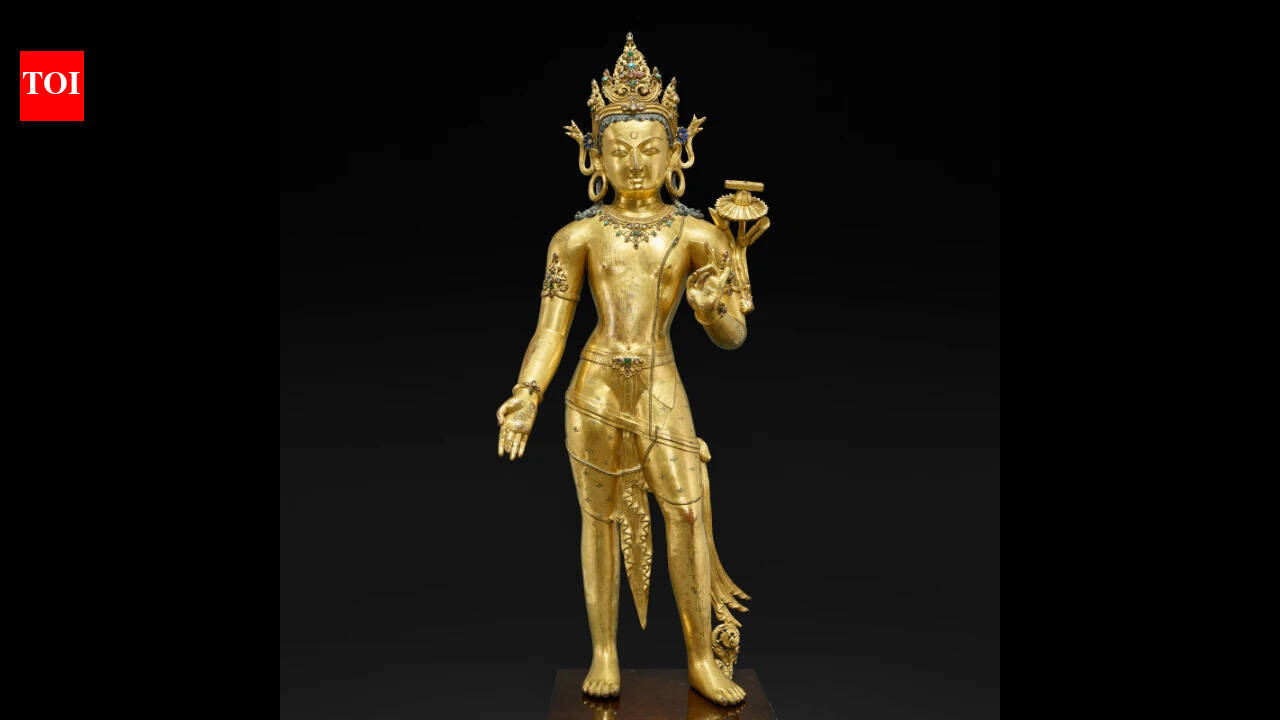
In the 12th century, Nepalese artisans made a 93cm gilt-copper Manjushri statue; after Geneva, New York and Asian collections, it sold for about Rs 166 crore in 2026, setting a Himalayan gilt-bronze a
Standing almost a metre tall, the gilt‑copper figure of Manjushri from the 12th‑century Kathmandu Valley is a striking example of Newar metalwork. The bodhisattva is rendered in a graceful tribhanga pose, with elongated limbs, delicate jewellery and a lotus‑bearing Prajnaparamita sutra at his shoulder, all shimmering under a mercury‑gilded surface.
The sculpture showcases the hallmarks of Newar craftsmanship: a fusion of Indian classical ideals with a distinctly Nepalese sense of proportion and ornamentation. Artisans of the period perfected mercury gilding to achieve a luminous finish, and their skill in casting large bronze forms allowed them to produce monumental figures that seemed to float despite their weight.
Beyond Nepal, these techniques traveled along the Himalayan trade routes. Tibetan monasteries commissioned similar gilt‑bronze bodhisattvas, and Newar masters taught local artists casting and gilding methods that reshaped Tibetan visual language. By the 13th century the influence reached the Yuan court in China, where Nepalese artists helped forge a Himalayan‑inspired style for imperial Buddhist commissions.
Few examples of such scale and finish have survived. After appearing in major museums and exhibitions, the statue entered a private Asian collection and was auctioned in October 2026 at Christie's Hong Kong. It fetched HK$137.35 million (about ₹166 crore), setting a world record for Himalayan gilt‑bronze art and underscoring the enduring value of Newar artistic legacy.